

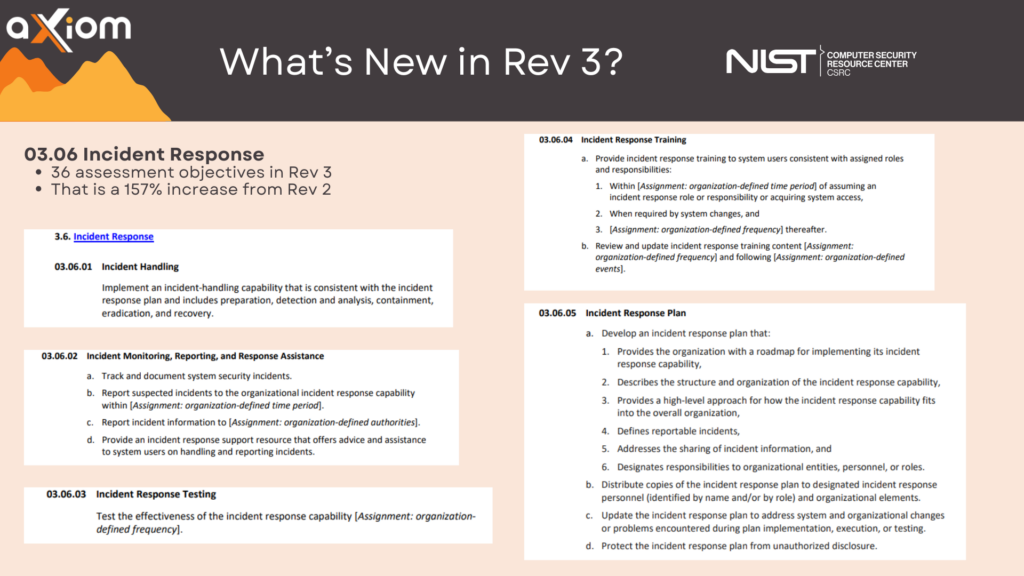
We are going over the major changes in NIST 800-171 Rev 3 piece by piece to really dive deeper into what they each mean.
And while 03.06 Incident Response may look small on the surface, the expectations underneath have expanded significantly.
The IR Domain Isn’t New… But It Is Different
If you are comparing Rev 2 and Rev 3, the first thing that stands out in the IR domain is:
Rev 2 stops at 03.06.03
Rev 3 includes”
-03.06.04 Incident Response Training
-03.06.05 Incident Response Plan
Because Rev 3 is no longer satisfied with organizations simply reacting to “if” incidents occur… they want more preparation for “when” incidents occur.
Now these organizations must:
- Train personnel
- Build structured plans
- Maintain and update procedures
- Define responsibilities
- Prove all of it
Not an “If” But a “When”
Incidents are not an “if”.
They are a “when”.
Even the most highly secured organizations can experience incidents. Because security is only as strong as the weakest user, configuration, and admin action.
Today’s threats are far more aggressive than earlier versions on these standards. And organizations are no longer dealing with simple malware alone.
Today, they are dealing with:
- Ransomware
- Advanced AI-assisted threat actors
- Credential theft
What Rev 3 is doing is reflecting these threats to properly prepare for that “when” moment.
It’s Not Just Technical Anymore
It’s organizational too.
Rev 3’s new requirements now emphasize preparation, detection, analysis, containment, eradication, and recovery.
Beyond that, Rev 3 also introduces higher expectations around communication, escalation, and accountability.
And, more importantly, users are expected to know how to report suspicious activity.
“See Something, Say Something”
An addition to 03.06 is the expectation that organizations must provide support resources to users for handling and reporting suspected incidents.
What does that mean?
Your users need to know what to do if something feels or is wrong.
That means organizations must create an environment where employees feel comfortable reporting:
- Suspicious emails
- Phishing attempts
- Strange login activity
- Accidental clicks
But if employees are afraid of being embarrassed or blamed, incidents can go unreported.
MSPs Will Feel the Burn
For MSPs supporting OSCs, these changes go much farther than internal policy updates.
Rev 3 impacts:
- SSPs
- SRMs
- Documentation
- Assessment preparation
And if MSPs are not mapping responsibilities down to the assessment objective level, gaps are going to appear quickly.
Especially as Rev 3 expands in depth.
The Real Takeaway
Rev 3’s 03.06 Incident Response changes are not about adding complexity for the fun of it.
They are adding it to prove accountability.
The expectation is no longer:
“Do you have security tools?”
It is now:
“Can your organization consistently respond to incidents in a structured, documented, repeatable way?”
And the organizations preparing now will have a much smoother transition than the ones that wait.
If you’re starting to plan your shift from Rev 2 to Rev 3 and have questions on how it’s broken down, feel free to reach out to us. Or check out our podcast, Climbing Mount CMMC to learn more.