

What Makes a Great System Security Plan?
A system Security Plan is the backbone of organizational security. They are living documents that guide how an organization safeguards its information systems, especially when handling Controlled Unclassified Information (CUI). For businesses seeking to meet NIST 800-171 and CMMC requirements, understanding how to develop, maintain, and execute an effective SSP is essential.
Handle your CMMC documentation with care. Doing so ensures compliance, protects sensitive information, and maintains audit readiness. Many CMMC documents are connected and intertwined. When you revise one, there are others that follow. This is why it’s essential to know where you are placing these documents and have a structured approach.
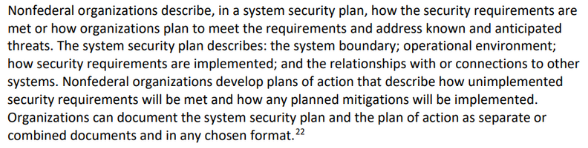
An SSP should speak to all 110 security controls of NIST 800-171 and 320 assessment objectives. This is not a new requirement for contractors in the DIB. DFARS clause 242.204-7012 has been requiring contractors to have an SSP for years now.
NIST 800-171 rv2:
What Does a Comprehensive SSP Really Include?
Many organizations approach an SSP as a simple list of controls. While controls are critical, a truly effective SSP goes much deeper. A well-crafted plan incorporates:
- System Scoping & Boundaries: Clearly defining what is inside and outside the security perimeter prevents costly audit failures. Overly broad scopes can make compliance unnecessarily complex, while incomplete scopes can leave critical systems exposed. It’s critical to get your scoping and boundary correct. Understanding your scope is something you’d need to know before creating your SSP.
*This image example includes both bad and good scoping practices. This should not be used as a template.

- Data Flow Management: Mapping how CUI moves through your systems ensures you understand exactly where it resides, how it’s processed, and where it might be vulnerable. In the context of CMMC —especially at Level 2, which aligns with NIST SP 800-171—data flow diagrams serve a crucial purpose in helping organizations identify, understand, and protect Controlled Unclassified Information (CUI) as it moves through their systems.
*This image example includes both bad and good scoping practices. This should not be used as a template. Taken from KNC Strategic Services

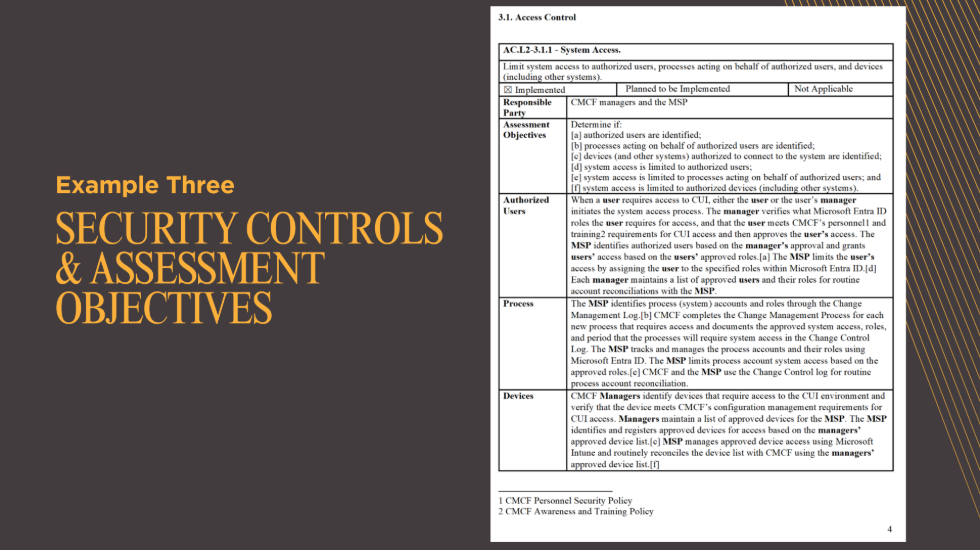
- Detailed Security Controls: CMMC controls are specific cybersecurity requirements and practices that organizations must implement to protect CUI and FCI. Assessment objectives break down each control into measurable, verifiable criteria used during an audit or self-assessment. These objectives guide assessors and help organizations clearly understand what’s expected to pass certification. Each control should be explained in detail: How was it implemented? Who is responsible? How is the effectiveness measured?
*This image example includes both bad and good scoping practices. This should not be used as a template.
The Role of Policies and Procedures
The SSP should be fully supported by well-defined policies and procedures. Without clear operational guidance, even the best-written SSP will fail in practice. Equally important is clearly outlining user roles and responsibilities. Every stakeholder (IT staff or system users) must understand their part in protecting CUI. Ambiguity here can lead to lapses in compliance and security incidents. Your policies and procedures provide the “proof” and “how-to” for those controls.
Together, they work like this:
- Policies describe what your organization commits to doing (e.g., “We will control access to CUI based on the principle of least privilege.”)
- They are organization-wide, approved by leadership.
- Procedures describe how those policy commitments are implemented day-to-day.
- They are often technical or role-based (e.g., how your IT team provisions user access).
Together, They Provide Assurance:
- An assessor will look at your SSP and say:
- “Show me how you do this.”
- You point to the related policy and procedure.
Collaboration Between MSPs and Clients
For organizations that rely on Managed Service Providers, building an effective SSP is a shared responsibility. MSPs often have deep technical expertise but need client cooperation to accurately define scope, document processes, and verify that all security requirements are met. Open communication and regular reviews help align expectations and ensure ongoing compliance.
Another aspect of this is inheritance. In the context of CMMC, inheritance refers to the ability of an Organization Seeking Assessment (OSA) to “inherit” the implementation and management of certain security controls from an External Service Provider (ESP)—such as a cloud provider, managed service provider, or data center host—that is responsible for those controls.
The Lifeline of a System Security Plan
An SSP is only as good as the documentation that supports it. Documentation management is critical. Not just for passing an audit, but for ensuring security practices remain effective over time. This includes version control, change tracking, and periodic reviews to keep the plan aligned with evolving threats and compliance updates.
This vital piece of CMMC is not a static compliance document, it’s a dynamic one. By ensuring your SSP is defined and communicative, organizations can build a plan that protects sensitive data and stands up for national security.
If you have more questions or would like to learn more about our services, check out our podcast episode or feel free to reach out.